The one-weekend bathroom refresh: curtain, hooks, rug and the tub
Measure on Friday, hang on Saturday, finish on Sunday: the curtain, twelve hooks, a rug, the tub and one frame, with the sizes and the order to do it in.

The room where small things do the most
A bathroom is the smallest room in most houses, and the one that asks for the least. White tile. A tub. A rod. A mirror. There is no lawn to mow and no open floor plan to rearrange. The room is mostly hard surfaces, so whatever soft things you put in it are the whole personality. One curtain. Twelve hooks. One rug. One shelf. That is the entire list.
In a rental, the walls are off-white because every rental's walls are off-white, and you are not going to repaint them. You are not going to call anyone. You are not going to replace the tub. But you can change everything the room touches, and the room touches very few things.
The bathroom is the room where twelve small things do the most.
Twelve hooks, specifically. A curtain rod holds twelve hooks. That is the whole set. Twelve small figures in resin, or twelve plain metal rings, and the curtain hangs from them. It is a small enough number to choose well. You do not need to decorate a room. You need to choose twelve hooks, one curtain, one rug, and maybe a frame. That is a Saturday's work, and the room will look like you meant it.
The order of the weekend
Do it in three passes. Friday night, measure. Saturday, wash and hang. Sunday, finish.
Measuring on Friday means Saturday starts with decisions already made. You will not stand in the bathroom at 10 a.m. with a tape measure and a curtain still folded in a bag, trying to remember if the rod is sixty inches or seventy-two. You will know. You will also know if the curtain reaches the tub and if the rug fits the floor in front of it.
Saturday is for the curtain, the hooks, and the rug. Wash the curtain first. Hang it while it is still slightly damp, or after it dries, but wash it before it goes on the rod. Fabric arrives folded, and the fold lines do not fall out on their own.
Sunday is for the tub and the shelf. The pillows, the stool, the frame. These are the finishing things. They take twenty minutes total, but they are the difference between a clean bathroom and a chosen one.
Measuring: Friday night
Take a tape measure and ten minutes. Write the numbers down. You will not remember them.
The rod. Measure its full width, rod to rod. A standard tub is about sixty inches wide, and the rod above it is usually a bit wider. You are not measuring the tub. You are measuring what the curtain has to cover. Write down the width.
The drop. Measure from the top of the rod to where you want the curtain to end. A curtain that stops an inch above the tub looks accidental, like it shrank. A curtain that touches the floor looks chosen, but in a rental the floor in front of the tub gets wet, and a curtain that pools on it stays wet. For most tubs, the right answer is a curtain that just clears the tub rim or hangs a little below it. The standard fabric curtain is 72 by 72 inches, and for a standard tub that drop works. Write down the number anyway, because your tub may not be standard.
The floor in front of the tub. This is where the rug goes, and the space is smaller than you think. Measure the depth from the tub edge to the nearest wall or door. A 20 by 30 rug fits most tub fronts. A 20 by 32 fits most of the rest. A 32 by 32 is a more generous square, if the floor allows it. A 24 by 60 runner is for a longer space, or for the side of a tub where you want the runner to run the length of it. Measure first. A rug that overlaps the door is a rug you will kick every morning.
The shelf. If there is a shelf in the bathroom, or a windowsill, or the back of the toilet, measure its depth. A frame with an easel stand needs a surface deep enough for the easel to spread. The shelf is where the room gets its second opinion. More on that Sunday.
| Measure | How | What it decides |
|---|---|---|
| Rod to hem | From the top of the rod to where the curtain should stop, usually just above the tub rim or the floor | 72×72 for a standard tub; a longer curtain for a high rod |
| Grommets | Count them; a standard curtain has twelve | One set of hooks; a double hook if a liner hangs too |
| Floor in front of the tub | The dry floor from the tub edge to where you stand | 20×30 or 20×32 for one step; 32×32 square; 24×60 along a tub or double sink |
| The shelf | Its depth, and the print you already have | A frame on the easel for a print size you own: 4×6, 5×7, 8×10 |
The curtain
The curtain is the largest thing in the room, so it sets the tone. For a standard tub, a 72 by 72 fabric curtain is the one to start with. It covers the opening, it clears the tub, and it is the size that hooks and rods assume.
Fabric, not vinyl. The Sunlit curtain is water-repellent and non-PVC. Water-repellent means water beads on the surface instead of soaking in. The curtain stays lighter, dries faster, and does not stick to your shoulder when you move past it. Non-PVC means the material is what it says it is. The EPA notes that concentrations of many volatile organic compounds are consistently higher indoors than outdoors, and that household products and furnishings are among the sources. Its practical suggestions are ventilation and following the label. It says nothing about shower curtains in particular, and we claim no health outcome for ours. We make fabric curtains, and a fabric curtain hangs quietly in a way a sheet of plastic never has.
The grommets are rust-proof metal, and the top header is reinforced. That is the part that takes the strain. The hooks slide through the grommets, the curtain hangs from the header, and a bathroom is a damp place where cheap grommets turn orange within a year. The prints are described as color-fast, which means the washing does not pull the color out. There are ombre blues, stripes, block prints, sage green checks, nautical anchors and sailboats, cartoon sea creatures, cats and dogs, and a few that are clearly meant for children. Choose the one that makes you want to be in the room. This is the first thing everyone sees.
Now the liner question. The curtain can be used with or without a liner. The deciding question is what you do after a shower. If you leave the curtain closed to dry, a liner keeps the fabric from staying wet against itself. If you pull the curtain open and let the air move, you may not need one. Many people skip the liner and the curtain dries fine. The fabric is quick-drying, which helps either way.
Wash the curtain before you hang it. Machine washable, quick-drying, and the fold lines fall out in the first wash. This is also the moment to decide on the liner, because you hang them together.
The hooks
Twelve to a set. That is the number a standard rod holds, and it is the number the sets come in. They fit standard shower rods. The curtain is sold separately, and the hooks do not care which curtain you hang on them.
There are two kinds. Sunlit's decorative hooks are cast in resin: pumpkins, maple leaves, pinecones, seashells, sea turtles, roses, sunflowers, bows, paw prints, ghosts, bats, black cats, wooden slices, boho knots and medallions, and crystal gems. The plain hooks are metal rings in gold, black, or nickel. The metal ones are described as rust-resistant, some with an oil-rubbed finish.
The resin figures are where the room gets its personality. Twelve pumpkins on a white curtain in October is a different room from twelve seashells in June, and the swap takes about two minutes. The same figure often comes in several colorways. The pumpkin comes in orange, white, and mixed. The pinecone comes in brown and snowy white. Christmas sets have trees with a star or with ball ornaments, snowflakes in silver, ornament balls, a white reindeer, a Santa, a snowman, and a farmhouse barn.
Choose the colorway against the curtain, not the wall. The wall behind is white tile and it does not care. The curtain is what you see, and the hooks sit against it all day. A gold ring against a deep blue curtain shows up warm and bright. The same gold ring against white tile disappears. A white pumpkin on a white curtain is nearly invisible, which is either the point or a mistake, depending on what you want.
Some of the metal rings are double hooks, with two rings on one hook, so the curtain and a liner hang on the same hook. That keeps the rod uncluttered. The crystal-gem lines have glide balls, small spheres on the ring that let the hook slide along the rod without snagging. If you open and close the curtain a lot, the glide balls are the difference between a smooth pull and a jerky one.
One of each in our range
A hook set, a curtain and a rug. Each shelf page has every size and colourway.
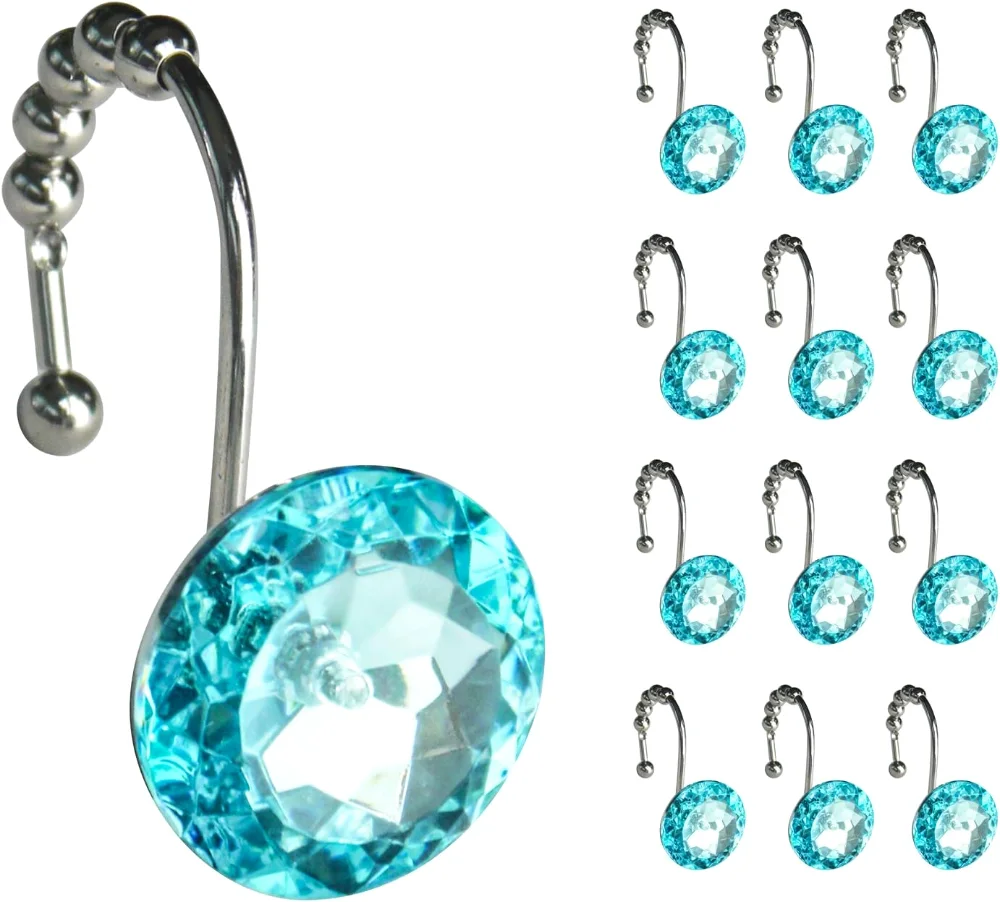
Round Teal Blue Crystal Gem Shower Curtain Hooks

Cute Paw Print Polished Shower Curtain Hooks
Black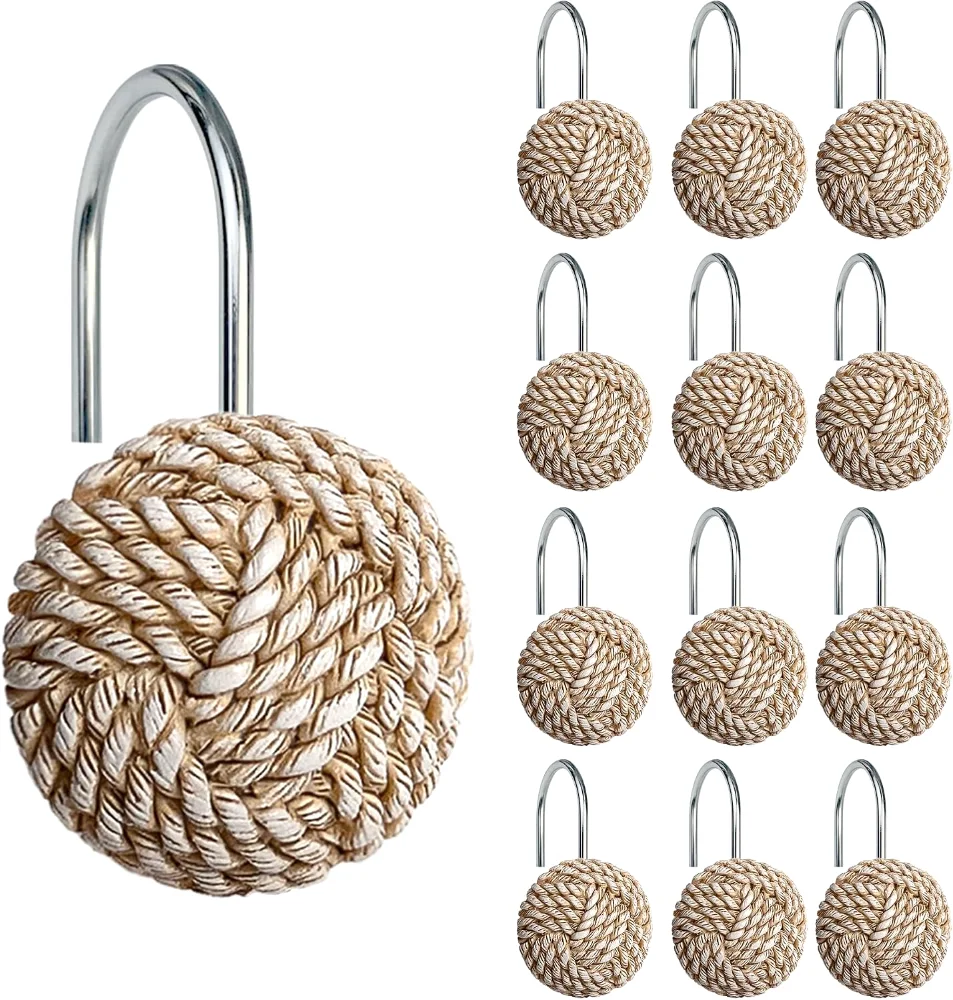
The rug
The rug is the second largest thing in the room, and the one your feet notice first. The bath rugs come in 20 by 30, 20 by 32, 32 by 32, and a 24 by 60 runner. The shag and chenille piles are described as absorbent and quick-drying, and the backing is non-slip.
A non-slip back wants a dry, clean floor. The grip works by friction, and friction needs contact. A wet floor or a dusty one is a worse partner for a non-slip back than a dry, clean one. So the rug goes down on a floor you have wiped. That is not a safety claim. It is how the thing works.
The machine washable part matters more than it sounds. A bath rug gets wet, stepped on, and occasionally dropped. Being able to put it through the wash and hang it to dry is what keeps it from becoming the thing you avoid looking at. The designs include textured mid-century arches, a pink bow, a misty forest, and a plain blue.
Here is what the CDC found, in its report on nonfatal bathroom injuries from 2008 data. An estimated 234,094 people aged 15 and older were treated in emergency departments for bathroom injuries that year. Eighty-one percent were falls. About two thirds happened in or around the tub or shower. The most hazardous activities were bathing, showering, and getting out of the tub or shower. Only 2 percent happened getting in. Injury rates rose with age. The report also noted that 63 percent of homes used bathtub mats or nonskid strips, but only 19 percent had grab bars. The CDC's own suggestion is grab bars, inside and outside the tub or shower.
A rug with a non-slip back is a comfort underfoot and a pleasant thing to stand on. It is not a substitute for a grab bar, and we make no claim beyond comfort underfoot. If you are installing grab bars, that is a different weekend and a different drill. The rug is for the part of the bathroom that is about standing barefoot on something soft.
| Where | What the CDC report found | What it means for the room |
|---|---|---|
| In or around the tub or shower | About two thirds of bathroom injuries; the most hazardous activities were bathing, showering and getting out | The step out of the tub is the moment: a dry, non-slip rug where the foot lands, and a grab bar |
| Getting in | Only about 2 percent of injuries | The wet foot on the way out is the problem, not the dry one on the way in |
| Falls | 81 percent of all bathroom injuries | Nothing on a floor should slide: a rug with a non-slip back on a clean, dry floor |
| Grab bars | 19 percent of homes had them in 2004; the report suggests bars inside and outside the tub or shower | A rug and a stool are what people add first; they are not a substitute for a bar |
The tub
The tub itself you are not replacing. But it can be more comfortable than it is, and the things that make it comfortable take no tools.
Bath Jello is a lumbar pillow for the bathtub. It is made of a soft, springy gel-like material with an open honeycomb structure, and it is used under water. It holds the lower back while you sit, and the open structure means it does not trap water against you. It air-dries in the tub, so you can leave it there. It fixes to the tub with two removable silicone suction cups, which means it stays where you put it, and it works on a smooth tub surface. Textured tub surfaces are not what suction cups are for.
The full-body bath pillow is a larger version of the same idea. It is about 49 inches long, made of air-mesh, with an adjustable lumbar section and suction cups. It covers more of the tub, for the person who wants to lie back rather than sit up. It is machine washable, and it comes with a laundry bag for that purpose, plus a hanging hook so it can dry between baths.
The one-step stool is the practical one. It is solid wood with an absorbent chenille top, 14 by 11 by 7 inches, and it is described as holding up to 550 pounds and being non-slip. It sits beside a tub, a bed, or a sink, and it is the thing you put a foot on when you step out of the bath. Getting out of the tub is, per the CDC, one of the hazardous moments. We make no safety claim for it. We make a stool that gives you a dry, stable place to put a foot, and children use them to reach the sink.
The shelf and the wall
Sunday afternoon, the shelf. This is where the room gets its second opinion. The curtain and the rug are soft and large. The shelf is where you put something small and deliberate.
The frames are vintage-style, cast in polyresin and brushed with gold, silver, bronze, or another finish, with a glass front. They come in the print sizes people actually have: 2.5 by 3.5 for the mini, then 4 by 4, 4 by 6, 5 by 7, and 8 by 10. The shapes are rectangular, oval, square, heart, and arched, and some come as sets of two.
The point is the size. A frame is not something you shop for and then find a picture to fill. You have the picture. You have the print, or the photo, or the postcard. You buy the frame that fits what you already have, and the sizes above are the ones that exist in the world. The back is easy-open, so changing the picture takes seconds, and it has an easel kickstand and hanging hooks, so the frame stands on the shelf or hangs on the wall. You do not have to choose at the store. You can stand it up and later hang it.
One frame on the shelf, or two, one standing and one hanging. That is enough. A bathroom does not need a gallery wall. It needs one thing that says a person chose it.
The wash schedule
The room will not stay chosen by itself. It needs a small rhythm, and the rhythm is simple.
The curtain goes through the machine when it starts to look tired. It is machine washable and quick-drying, so this is not a project. Pull it down, wash it, hang it back up. The grommets are rust-proof, so the wash does not hurt them, and the prints are color-fast, so the wash does not pull the color out.
The rug goes through the machine on the same schedule, or more often if it sees more feet. Machine washable, hang to dry. The non-slip back survives the wash, which is the whole point of buying a washable rug instead of a decorative one.
The hooks get wiped. A damp cloth, once in a while, to take off the film that bathrooms deposit on everything. The resin figures do not rust and the metal rings are rust-resistant, so the wipe is about dust and soap scum, not damage. Some of the metal rings have an oil-rubbed finish, and the wipe is all they need.
The swap is the fun part. The hooks are twelve pieces, and they come off the rod in under a minute. The pumpkins go up in October and come down in November. The Christmas sets go up after Thanksgiving. The seashells and sea turtles go up in June. The swap costs nothing and changes the room as much as a new curtain would. The same rod, the same curtain, twelve different small figures, and the room is a different season.
Sunday night
Sunday night, stand in the doorway and look. The curtain hangs straight, because you measured and because you washed it first. The twelve hooks hold it, and they are the thing you chose, not the thing that came with the rod. The rug is down on a clean, dry floor, and your feet already know the difference. The tub has a pillow in it, and the stool sits beside it. The shelf has a frame, and the frame has your picture in it, because you bought the size you actually have.
No one was called. Nothing was repainted. The landlord's white tile is still the landlord's white tile. But the room looks chosen. It looks like someone walked in, looked around, and decided what this room was for.
That is the whole trick. A bathroom is a small room with a short list of things in it. Curtain, hooks, rug, tub, shelf. Five items, and one of them, the hooks, is twelve items pretending to be one. You did it in a Saturday and a Sunday, and the cost was hours, not dollars. The room will not stay that way by itself. It needs a wash now and then, and a swap of the hooks when the season turns. But that is not upkeep. That is the part where you get to choose again.
Sunlit makes the pieces this room is finished with. The curtains, the twelve-hook sets, the rugs, the pillows, the stool, the frames. Not the tile, and not the landlord. The small things, in the sizes that fit.
This article is general information about furnishing a bathroom, drawn from the public bodies cited below. It is not safety advice: a rug, a mat or a stool is not a claim that a bathroom is safe, and the CDC report we cite recommends grab bars for the tub and shower, which none of our products replace. For a household with someone unsteady on their feet, an occupational therapist or a physician is who to ask.